

Q&A
The "5E" Learning Model: Maximizing Corporate Value
-
Effective: Delivers tangible results and boosts profitability.
-
Efficient: Saves time and costs; achieves more with less.
-
Elegant: Innovative, advanced, and world-class.
-
Easy: Simplifies complexity; deep insights made easy.
-
Enjoyable: Team building that makes learning a joy
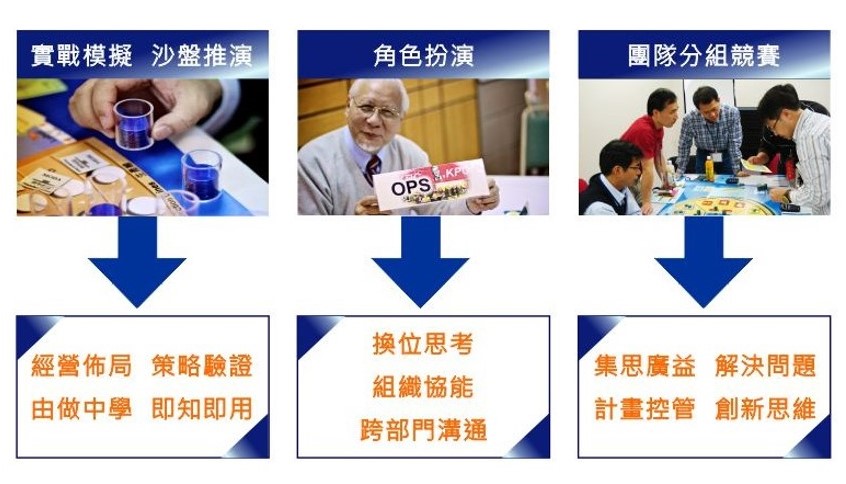
EIS Real-World Simulation The course begins by dividing participants into small groups to assume the roles of department heads. Through comprehensive business simulations ("wargaming"), participants gain a holistic view of the enterprise by rotating and managing operations across Production, Marketing, HR, R&D, and Finance.
By collaborating, brainstorming, and competing against other teams, participants learn to step into others' shoes and enhance cross-departmental communication. They are challenged to transform limited resources into maximum profit and market value. Finally, each group presents an actionable improvement plan, followed by implementation and performance tracking.
Challenge 1: The second generation is unwilling to endure the same hardships in doing business as the first generation.
Challenge 2: Managers and employees are hesitant to take over the company due to uncertainty about the business's status.
Challenge 3: Passing the business to a third party is difficult due to the lack of established trust.
Challenge 4: Evaluating the transfer price is complex, particularly regarding intangible value and assets.
Challenge 5: How can successors and operators integrate with long-serving employees to form an effective team?
Challenge 6: During the succession process, how can the tangible and intangible needs of veteran employees, founding owners, and the succession team be met simultaneously?
Challenge 7: How can the new management ensure the business becomes more successful or achieves a turnaround from loss to profit?
Does the following story and its protagonist seem familiar to you?
Boss Wang has run a restaurant for nearly 30 years. This establishment, known as "Stop for the Aroma" (Wen Xiang Xia Che), is quite famous in town. Although business has been affected by the recent economic downturn, revenue remains stable due to its delicious food, reasonable prices, and high popularity. However, due to the impact of COVID-19 and the fact that Boss Wang and his wife both fell ill last year (though they have since recovered), he has started thinking about retirement.
Boss Wang’s two children have no interest in the restaurant business. The couple feels that since one child is an engineer and the other a junior high school teacher—both with stable jobs—there is no need to force them to take over the family business.
However, Wang has absolutely no clue how to pass the business on or sell it. Previously, real estate agents introduced potential buyers, but the deals fell through due to significant gaps in price expectations and Boss Wang's doubts about whether the buyers intended to maintain the restaurant's unique character.
In fact, Boss Wang has a young head chef, Little Chen, who has worked with him for nearly ten years. Chen possesses excellent skills, integrity, and loyalty. He has turned down several head-hunting attempts out of gratitude for Boss Wang’s kindness. Little Chen is also ambitious and creative, often experimenting with new dishes, which Boss Wang encourages. However, handing the restaurant over to Little Chen—and how to structure the transfer—is a problem. Although Wang knows Chen is frugal and has saved nearly one million dollars, he surmises it is insufficient to buy a restaurant, let alone an established one like "Stop for the Aroma."
Actually, what Boss Wang and his wife truly care about isn't just the selling price. They hope to find an ideal successor who will treat the employees well, keep the restaurant running sustainably, provide high-quality and affordable dining to the community, and expand the brand across Taiwan. Yet, they remain at a loss on how to achieve this. In reality, the daily grind from early morning to late at night continues with no end in sight...
Does this story sound familiar?
This narrative reflects the reality for many Small and Medium Enterprise (SME) owners across various industries in Taiwan. According to statistics from PWC Taiwan, less than 9% of family businesses in Taiwan are fully prepared for succession.
The issue of business succession is a critical socio-economic topic for Taiwan and all advanced nations. If we can find a way to solve this, it will increase Taiwan's GDP and GNP, raise employee wages and living standards, and reduce the waste and inequity caused by business closures or improper transfers. Ultimately, this will help secure the fruits of Taiwan's democratization over the past 25 years.
-
Difficulty in Valuation Assessing the true value of an SME is notoriously difficult. Financial records and reports are often inaccurate or unclear. Even when books are transparent, valuing certain assets—particularly intangible ones—remains a significant challenge.
-
Lack of Financial Acumen Most founders possess a risk-taking spirit and build their businesses based on specific technical expertise or experience. However, they often lack management acumen, particularly in accounting and finance. Consequently, they may lack the proper perspective when discussing business valuation. Since SMEs are not publicly traded and vary widely in industry and scale, accurate valuation is even more elusive. Therefore, business owners and leadership teams must possess basic and accurate financial knowledge to ensure that buyers and sellers avoid exorbitant demands or unreasonable price slashing during negotiations.
-
Limited Access to Capital Venture Capital (VC) firms, Private Equity (PE) funds, and banks mostly target emerging high-tech, biotech, IoT, and other "sexy" modern sectors. They rarely show interest in traditional industries or the service sector. Consequently, it is relatively difficult for individuals to self-fund or pool capital to invest in traditional SMEs.
-
Underinvestment in Growth Accustomed to frugality or pressured by large corporate clients to provide low-cost goods and services, SMEs operate with thin margins. As a result, they typically invest very little in branding, marketing, R&D, and modern management systems. The result is that even if they generate enough profit to maintain operations, their accumulated intangible value remains low, and the talent they nurture often lacks competitiveness.
-
The Talent Dilemma Regarding talent, SMEs suffer from structural disadvantages. Every year, top university graduates are prioritized by large listed companies and high-tech firms. SMEs often hire graduates from less popular majors who frequently require retraining. Because their academic background often does not match their job functions, these employees struggle to commit to a specific industry or stay with one company for long, creating a vicious cycle. However, many successful SMEs thrive because their owners take special care of their employees—regardless of their academic pedigree—by investing in their training and nurturing them.
-
Lack of Succession Training Regardless of size, every enterprise needs to properly train successor leaders and employees. They must plan for the future through collective brainstorming and implement company strategies. However, SMEs rarely invest sufficient resources in leadership and knowledge training.
-
Cultural Cohesion It is crucial to foster a culture of mutual trust and reciprocity, uniting the wisdom and strength of both new and veteran employees and the management team. Only by achieving internal unity and mutual trust can a company hope to gain the trust of customers, investors, and the general public.
-
Legal and Ethical Considerations Finally, legal issues such as Intellectual Property Rights (IPR), trademarks, patents, trade secrets, and data security cannot be ignored. These issues impact the trust of society, employees, buyers, sellers, and investors, as well as legal liabilities. Furthermore, even if no laws are broken, business ethics must be prioritized to ensure smooth succession. The recently popular ESG (Environmental, Social, and Governance) concepts are also worthy of attention and study for SMEs.